Kaleiçi Guide: Antalya's Old Town Romantic Streets and Hidden Courtyards
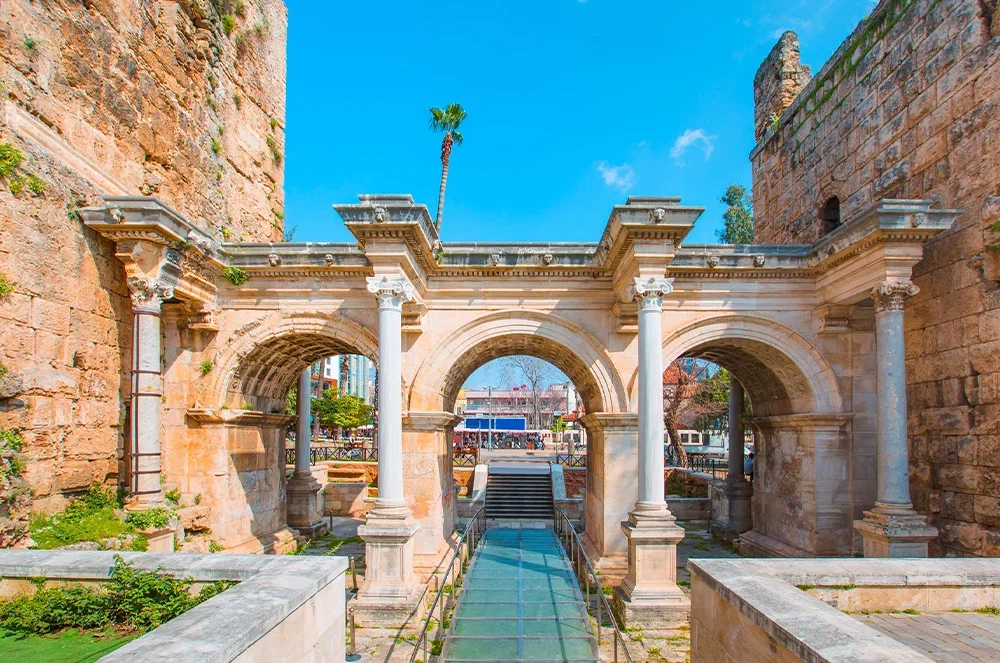
The Mediterranean afternoon sun slips through narrow stone streets. From deep in a courtyard comes the scent of cinnamon and orange blossom; a few steps away a coppersmith has been striking the same basin for ten minutes. Three paces further, you pass beneath a marble gate raised two thousand years ago — built for Emperor Hadrian's arrival in Antalya in 130 AD, three arches, still standing. This is Kaleiçi: Antalya's historic heart, a city that has beat upon the same stones for two millennia.
Nearly every guest who stays at a Kirman Premium hotel discovers the value of devoting one day of their holiday to Kaleiçi. The reason is clear: Antalya is not visited for the sea alone, and no Antalya holiday is complete without seeing Antalya itself. This guide brings together the narrow streets of Old Town Antalya, its hidden courtyards, the Yivli Minaret glowing in the evening light, the sunset from Hıdırlık Tower and the magic of the Marina — with a practical and romantic narrative. From how to plan an afternoon hour by hour to which hotel suits you best, every question finds its answer here.
What Is Kaleiçi and Why Visit?
Kaleiçi — literally "inside the castle" — is a historic district of roughly three square kilometres in central Antalya, enclosed by the remnants of ancient city walls. It is an open-air museum in the purest sense, layering Roman, Byzantine, Seljuk and Ottoman periods one atop the other. Today it houses more than 2,000 restored Ottoman-era houses, artist studios, boutique hotels, small restaurants, tea houses and antique dealers. Because it is a pedestrian zone, the district is explored on foot only; vehicle access is strictly limited.
Kaleiçi in brief: Antalya's walled historic centre — an open-air museum standing from the Roman era (2nd century AD) to today. It contains Hadrian's Gate, the Yivli Minaret, Hıdırlık Tower, the Truncated Minaret (Kesik Minare) and the Yacht Marina. Covering roughly 3 km², the area is explored exclusively on foot; a day trip allows the main landmarks to be seen in three to five hours. It lies 15 km from Antalya Airport, roughly 65 km from the Side region where Kirman Premium hotels are based, and 100 km from Okurcalar.
The strongest reason to visit Kaleiçi is that here you can sense Antalya's millennial continuity in a single walk. The stone road where Hadrian's feet once fell, the square where the Seljuks raised the Yivli Minaret, the wooden-bay Ottoman houses and today's artist studios all stand side by side. Another reason is the atmosphere itself: late-afternoon light across the Marina's illuminated coves, summer street-concert sounds rising from courtyards, the sweet scent of orange trees, the golden glow of the Mediterranean afternoon — each leaves a sensory memory far stronger than a photograph.
Layers of History — From Rome to the Ottomans
Kaleiçi — "within the walls" — is precisely what the name implies: the old city preserved behind fortifications. Beneath every stone you walk on lies the trace of a different age. Antalya was founded in 150 BC by Attalus II, King of Pergamon, who chose this natural Mediterranean cove as his port city and named it Attaleia. Under the Romans the city flourished; its peak came in the 2nd century AD, and Hadrian's Gate is the living inheritance of that moment.
Roman Era: Hadrian's Gate and Hıdırlık Tower
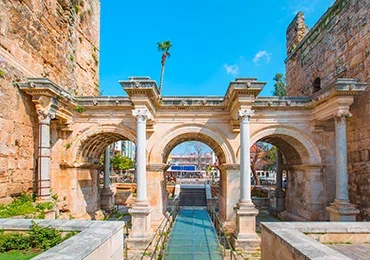
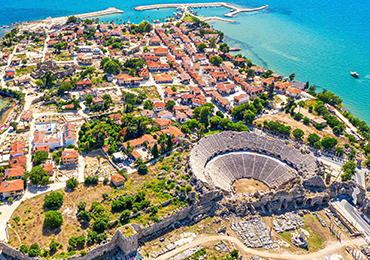
Hadrian's Gate (Üçkapılar — "Three Gates") is a triple-arched marble monument erected in 130 AD in honour of Emperor Hadrian's visit to Antalya. All the grandeur of Rome stands in one structure: red granite columns, white marble friezes, laurel-leaf motifs. Pass beneath the arches and you will notice the grooves in some of the paving stones — ruts worn two millennia ago by chariot wheels. This is not a touristic reconstruction; it is the original, in situ, upright.
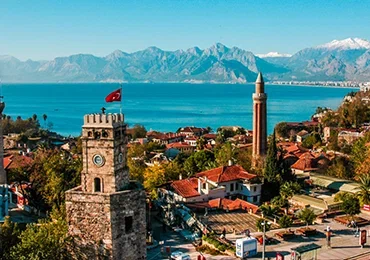
Hıdırlık Tower, by contrast, is an even earlier example of the same period. A cylindrical tower thought to have been built as a Roman lighthouse in the 2nd century AD, it stands at the end of Karaalioğlu Park on a promontory overlooking the sea. Fourteen metres tall and 13.4 metres in base diameter, it has served as funerary monument and watchtower over its long life. Standing before the tower today at sunset, you sense that the same vista was watched two thousand years ago by Roman mariners.
Seljuk Era: The Yivli Minaret
Built in the 13th century during the reign of Seljuk Sultan Alaeddin Keykubad I, the Yivli Minaret is the emblem of Antalya. At 38 metres tall, its eight-fluted (channel-shaped) design has dominated the city skyline for centuries as a refined example of Seljuk architecture. The brickwork, turquoise-tiled shaft and silhouette — visible from every street — are what make Antalya instantly recognisable in Kaleiçi photographs. The Yivli Minaret Mosque, together with its adjacent medrese and mausolea, forms the core of Antalya's Islamic architectural heritage.
From Byzantium to the Ottomans: Kesik Minare
The Kesik Minare (Truncated Minaret) summarises Kaleiçi's layered history in a single building. It was first built as a Roman temple, transformed during the Byzantine period into a church dedicated to the Virgin Mary, then converted into a mosque under the Ottomans. In the 19th century, a fire destroyed the upper portion of its minaret, and the building has kept the name "Truncated" ever since. Still under restoration, it contains two millennia of religious, architectural and cultural strata beneath the same four walls — among the most striking stops on a Kaleiçi walk.
Ottoman Houses: 18th–19th Century Fabric
Kaleiçi's layered "cake-like" stone-street texture largely belongs to the 18th and 19th centuries. Timber-bayed houses, stone ground floors, courtyards at the core — traditional Turkish domestic architecture, nearly all restored today and serving as boutique hotels, pensions, galleries or cafés. Stepping into a courtyard and drinking coffee under the shade of an orange tree is Old Town Antalya at its most authentic. The architectural richness of Kaleiçi gains a broader context when read together with our guide to Antalya's historic treasures — ancient cities and museums.

How Old Is Hadrian's Gate?
How old is Hadrian's Gate? Hadrian's Gate was built in 130 AD to honour Roman Emperor Hadrian's visit to Antalya (then known as Attaleia). As of 2026, the monument is 1,896 years old. A triple-arched structure of white marble and red granite columns, it is the only surviving original gate of Antalya's ancient city walls and is considered among the best-preserved examples of Roman architecture in Turkey.
A Walking Route — An Afternoon Hour by Hour
A good Kaleiçi visit is really a matter of time architecture. Early-morning entries can be exhausting in the hot months, while night tours miss the magic of certain courtyards in the dark. The formula our Kirman Premium concierge most often recommends is "afternoon start, evening climax." Here is an ideal itinerary:
15:00 — Enter Through Hadrian's Gate
As you approach on foot from Atatürk Avenue, the triple-arched marble structure suddenly appears before you. Spend the first five minutes simply looking — at the ceiling motifs beneath the arches, at the colour of the stones, at the Roman remnants in the side walls. The moment you pass through, the stone road begins and time shifts; you are now inside a dense Roman city.
16:00 — Yivli Minaret Square
Descending through narrow streets to Yivli Minaret Square reveals Antalya's most photogenic panorama. Sit in the square, buy a cone from a local ice-cream maker, and walk through the medrese courtyard beside the minaret. The marble fountain, Seljuk ornamentation and fluted brickwork of the minaret are far more impressive when studied up close. Most photographers spend 20–30 minutes here.
17:00 — Hıdırlık Tower and Sunset in Karaalioğlu Park
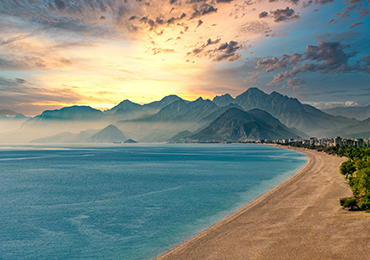
Walk to the southern tip of Kaleiçi, towards the promontory overlooking the sea. Come to the base of Hıdırlık Tower inside Karaalioğlu Park, and sit down. Between June and September, the sun descends into the Mediterranean between 19:30 and 20:30, and the Bay of Antalya lights up like an orange-pink canvas. Watching the sunset at the foot of a two-thousand-year-old Roman lighthouse is the 20 minutes most guests remember most vividly from their Antalya holiday.
18:30 — The Marina (Yacht Harbour) and Mermerli Beach
After sunset, walk down to the Marina. The revitalised yacht harbour becomes a different world under evening lighting: illuminated yacht masts, live music spilling from waterfront restaurants, couples walking hand in hand along stone jetties. Mermerli Beach, in a small cove just beside the Marina, is Kaleiçi's most authentic swimming spot — you can cool off in its blue water by day, and dine on its terrace restaurants facing the Mediterranean by evening.
20:00 — Dinner and Street Atmosphere
Kaleiçi's true magic begins after 20:00. The narrow streets lose their heat, and small courtyard-restaurant lights come on. For a traditional "meze and wine" table, choose one of the terraces on the streets climbing up from Mermerli Beach. On certain summer evenings, free street concerts are held inside Kaleiçi — step into a courtyard and you may happen upon the sound of an oud in the Nef maqam. After dinner, private transfer organised by our Kirman Premium concierge is the easiest way back to the hotel: arrival times around 22:00–22:30.
How Long Does Kaleiçi Take to Explore? Seeing the main landmarks on foot (Hadrian's Gate, Yivli Minaret, Hıdırlık Tower, Marina, Kesik Minare) takes 3–4 hours. With photo breaks, ice-cream, coffee and a few studio visits, the ideal duration is 5–6 hours. Adding dinner extends the day to 7–8 hours. At 3 km² it is not a strenuous walk — but comfortable shoes are essential, as the stone streets are uneven.
Seven Places You Must See
Getting lost in Kaleiçi is partly the point — every street holds a courtyard, a wooden bay window, an antique shop. But there are seven landmarks without which an Antalya holiday is incomplete:
1. Hadrian's Gate (Üçkapılar): 130 AD, Roman period. Antalya's most famous symbol. On Atatürk Avenue, at the entrance to Kaleiçi.
2. Yivli Minaret: 13th-century Seljuk masterpiece. Antalya's skyline is incomplete without it. On İmaret Street.
3. Hıdırlık Tower: 2nd-century Roman lighthouse. Southern tip of Karaalioğlu Park — first class for sunsets.
4. Kesik Minare (Truncated Minaret): Roman temple → Byzantine church → Ottoman mosque. Two millennia of religious layers in one structure.
5. Antalya Museum: Just west of Kaleiçi, a 15-minute walk. World-class collection of Roman sculptures from Perge, Aspendos and Side. Among Turkey's finest archaeology museums.
6. Yacht Marina: Revitalised harbour. Famous for evening lighting and terrace restaurants. Mermerli Beach just next door.
7. Clock Tower: 19th-century Ottoman. In Kalekapısı Square, the northern gateway of Kaleiçi where it meets Atatürk Avenue.
For travellers who also wish to visit Perge, Aspendos and the other ancient cities of the region, our Perge and Aspendos guide extends the Kaleiçi visit into a broader cultural journey. For the historic traces on the Side side, our Side sightseeing guide is the natural companion.
Food and Shopping in Kaleiçi — Authentic Stops
Kaleiçi may be Antalya's busiest tourist district, yet for those who know the right addresses it still offers an authentic experience. Over the years our Kirman Premium concierge has compiled a short list: a small meze table in a stone-walled courtyard, seafood terraces above Mermerli Beach, a traditional künefe house near Yivli Minaret, a handmade ice-cream shop on the road to Hıdırlık Tower. The little white-linen restaurants along the main avenue between Hadrian's Gate and the Marina tend to be more authentic; but for deeper flavour, choose the venues set within inner courtyards away from the street.
As for shopping, Kaleiçi is paradise for antique lovers. Silverwork, handwoven carpets, ceramics, glass trinkets, leather, olive-oil soaps — each street highlights a different craft. For those seeking traditional Turkish arts and local products beyond Kaleiçi, our Antalya shopping and bazaar guide points to further routes. But what is unique to Kaleiçi is this: most of the vendors here are also the craftsmen themselves — the copper pot you purchase may have been hammered in a workshop two doors away.
Evening Atmosphere — Kaleiçi's Magic Hour
To truly feel Kaleiçi's character, you must wait for evening. After sunset the district takes on an entirely different personality. The heat eases, the stone streets cool, the restaurant terraces begin to fill. The Marina's evening lighting reaches full brightness around 20:30: yacht masts, waterfront restaurants and dock lamps together form a silhouette reminiscent of a miniature Cannes.
Between June and September, free street concerts occasionally take place inside Kaleiçi — Turkish classical music, classical guitar recitals or jazz quartets. The acoustics of the courtyards are a gift of history; thick stone walls enrich every note. No advance plan is needed; a concert you happen upon while strolling leaves a memory deeper than any scheduled event. The evening offers two different points of attraction: the lively, photogenic brightness of the Marina, and the quiet, romantic half-darkness of the narrow streets near Hıdırlık Tower. Experiencing both in a single evening reveals Kaleiçi's two faces at once.
Evening or Day — Which Is Better? If you want to truly experience Kaleiçi, the answer is: both together. The ideal formula is to enter around 15:00–16:00 in the afternoon, see Hadrian's Gate, Yivli Minaret and Hıdırlık Tower in daylight, then watch sunset at around 19:00 and spend the evening in the Marina and restaurant atmosphere. This way you see the monuments in their proper light and also live the district's magical evening character.
Who Is Kaleiçi For?
Couples and Honeymooners
Kaleiçi is one of the most romantic corners of the Antalya region. Hand-in-hand walks through stone streets, a sunset at Hıdırlık Tower, a candlelit dinner on a Marina terrace — most honeymoon couples devote their most special evening in Antalya to Kaleiçi. Our Premium Honeymoon concept guide offers additional ideas for a romance-focused holiday, while the Honeymoon concept page details the bespoke package for couples.
Families
For children aged eight and above, Kaleiçi becomes a living history lesson. The arches of Hadrian's Gate, the spiral stairs of Hıdırlık Tower, the giant marble sculptures at Antalya Museum — each transforms what they read in books into something tangible. For families with very young children, a practical solution is to limit the Kaleiçi programme to two hours, focusing on ice-cream and the fountains at the Marina. For the remainder of a family holiday, our aquapark family hotel comparison is a useful companion.
Culture Lovers and Photographers
For those drawn to history, architecture and photography, Kaleiçi is effectively a laboratory. Roman, Byzantine, Seljuk, Ottoman and present-day Mediterranean life converge within the same 3 km². The strongest photo hours are morning 08:00–09:00 (while narrow streets remain empty) and evening 18:30–19:30 (golden hour). Professional photographers sometimes allocate two or three days to the district; for amateurs, a dense afternoon suffices.
Practical Information — Transport, Parking, Attire
Transport: Kaleiçi lies 15 km from Antalya Airport, around 20 minutes by car. It is 65 km from the Side region where Kirman Premium hotels are based (about one hour) and 100 km from Okurcalar (around 1 hour 30 minutes). Our concierge arranges private transfers through partnered services; group tours collect guests from the hotel in the morning and return them at night. Within the city of Antalya, the AntRay tram connects to Kaleiçi at Saat Kulesi/Kalekapısı station. For general travel information, our Antalya flight and transfer guide provides useful orientation.
Parking: Vehicle entry into Kaleiçi is extremely limited — most streets are pedestrianised. The closest parking options are the indoor garages near Kalekapısı Square and the open lots on the Karaalioğlu Park side. Hourly fees are around 40–60 TL. If arriving by your own car, taking the AntRay tram into Kaleiçi avoids parking concerns entirely.
Attire: Comfortable walking shoes or quality sandals are essential — the stone streets are uneven; high heels are extremely difficult. Light cotton or linen is ideal in summer, with a thin scarf useful against the evening chill. For mosque visits (Yivli Minaret Mosque, Kesik Minare), trousers or skirts covering the knees and a shoulder cover are recommended. Sunglasses, hat and sunscreen are mandatory in summer months.
Best season: March–May and September–November are the ideal windows for Kaleiçi. Though June–August is hot, the district remains popular for its evening atmosphere. In winter (December–February), the streets are calm and the weather mild — offering a special silence for photographers.
Kaleiçi tips for 2026: Busiest hours are 11:00–14:00 — hot and crowded. Best photo spot: the western side of Hıdırlık Tower (for sunset) and the angle from the Yivli Minaret medrese courtyard looking up (in the morning). Keep your wallet in a front pocket, the usual touristic reminder applies. Admission: Hadrian's Gate and Hıdırlık Tower are free; Antalya Museum approximately 450 TL (2026 estimate); Yivli Minaret Mosque is open to visitors outside prayer times.

From Kirman Premium to Kaleiçi — A Day Trip
If you decide to dedicate one day of your holiday to Kaleiçi, departure from Kirman Premium hotels is straightforward. Guests staying in the Side region (Sidemarin, Calyptus) are only 65 km from Kaleiçi — an afternoon departure with a night return is feasible. For those in the Okurcalar region (Sidera, Arycanda, Leodikya), the 100-kilometre route, when planned according to summer hours, is never exhausting. Our concierge orchestrates 10:00 departures and 23:00 returns as a premium experience: private transfer, optional guide, pre-reserved dinner on a Marina terrace.
For a broader view of Antalya's day-trip options, our Antalya day tours guide offers several alternatives. To combine a beach-focused day with a culture-focused Kaleiçi day in one holiday, our best beaches of Antalya article guides you through the ideal rhythm.
If you are still deciding which hotel suits you best, our 5 Kirman Premium hotel comparison guide provides a clear framework. The general philosophy of the Kirman Premium cultural concept is worth reading on the Premium for Universe concept page; for brand background, the About page describes the brand's place along the Mediterranean coast.
Final Words: Kaleiçi, Antalya's Quiet Monument
Kaleiçi is a place to which tourist brochures devote a single page — yet whose true value cannot be grasped on that page. To walk, to sit, to eat an ice-cream in a courtyard, to fall silent for twenty minutes before Hıdırlık Tower looking out at the Mediterranean — these experiences form the wordless memories of your Antalya holiday. When you return home you will remember Kaleiçi not in words but in feeling: the scent of orange blossom, the rhythm of the coppersmith's hammer, the brick-red of the Yivli Minaret, the orange glow of Hıdırlık Tower at sunset.
After your June 2026 booking at a Kirman Premium hotel, our concierge plans your Kaleiçi day at the exact rhythm you desire: a romantic evening for couples, a culture-focused family tour, or a professional walk for photographers. Whatever style you choose, the bond you form with a two-thousand-year-old city on the stone streets of Kaleiçi becomes one of the most valuable pieces of your premium holiday.
-
 Summer Enjoyment Continues at Kirman Premium with Heated Pools!
 -
 Kirman Premium At ATF 2026!
 -
 Oktoberfest Excitement at Kirman Premium
 -
 Starry night at Sidera Kirman Premium: Gökhan Tepe
 -
 Republic Day 2026 in Antalya: A Four-Day Break at the End of October
 -
 October Half Term in Antalya 2026: A Family Guide to Autumn Sun
 -
 Antalya in October 2026: Weather, Sea Temperature and Can You Swim?
 -
 Oktoberfest in Antalya: Bavarian Spirit in September and October
 -
 Things to Do in Antalya in September: Festivals and Late-Summer Events
 -
 Things to Do in Antalya in August: Events and Summer Activities
 -
 Antalya in August: Sea Temperature & Weather Guide 2026
 -
 September in Antalya 2026: Warmest Sea, Calmest Season
 -
 Dim River & Dim Cave: Alanya's Cool Valley 2026
 -
 Green Canyon Boat Tour 2026: A Cool Escape from Side
 -
 Night Museum 2026: Side & Aspendos Ancient Cities by Moonlight










![Kirman Premium 5 Hotel Comparison: Which Resort Is Right for You? [2026]](https://www.kirmanpremium.com/image/icerik/6985529a11cfe.png)









Special offers for you Join the Kirman Premium world!







#kirmanpremium


