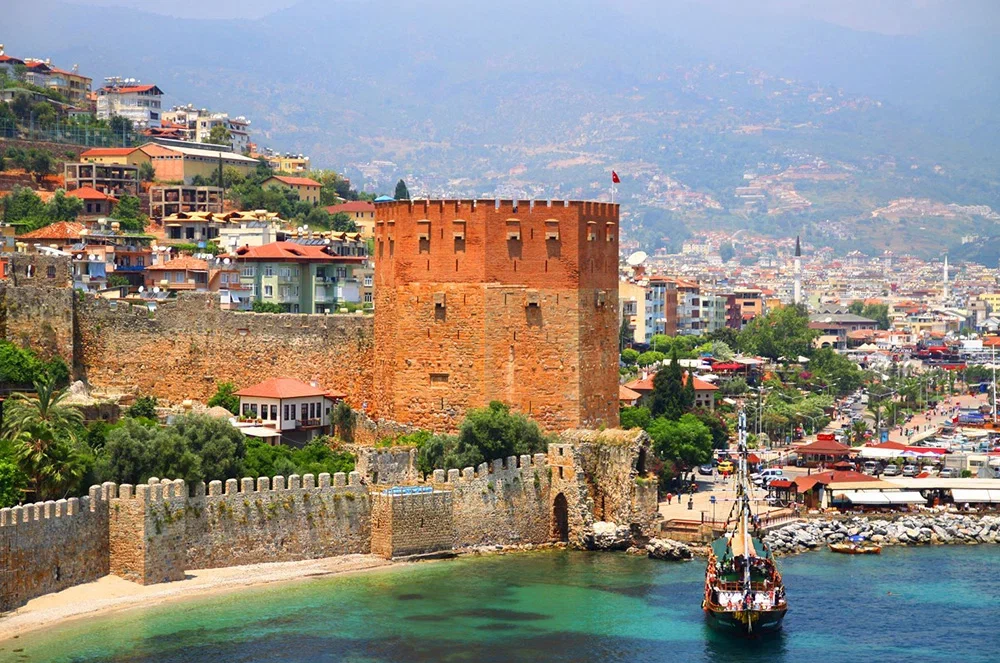
Alanya Castle, Red Tower & Shipyard: A Day-Trip Guide 2026
The Mediterranean blue pauses at the foot of the Taurus Mountains. Before you rises a rocky promontory 250 metres high; on top of it sits a Seljuk castle carved into stone eight centuries ago, an octagonal red-brick tower, and a medieval shipyard opening onto the sea through five arches. Here, a Seljuk sultan proved his power on both land and sea at once — Alaeddin Keykubad, by commissioning the Alanya Shipyard, earned the title "Sultan of Two Seas". This is not the story of a day trip; this is the story of a memory.
Just thirty minutes by road from the Okurcalar region where the Kirman Premium hotels stand, the Alanya Castle complex — castle, Red Tower and Seljuk Shipyard — is one of the most powerful cultural anchors on the Turkish Mediterranean. Inscribed on the UNESCO World Heritage Tentative List, the complex receives approximately 1.7 million visitors per year; yet visited at the right hour and along the right route, what greets you is not a crowd but the eight-century breath of a Mediterranean city. This guide builds an hour-by-hour day at Alanya Castle for guests staying at Sidera, Arycanda or Leodikya, weaving history, architectural narrative and practical detail into a single read.
What Is Alanya Castle and Why Visit?
Alanya Castle is a Seljuk fortress built on a peninsula on the Mediterranean coast, with 6.5 kilometres of walls and more than 140 towers. The highest point of the peninsula, the Inner Castle, stands 250 metres above sea level. The castle consists of three layers: inner castle, middle castle and lower castle. In 2009 it was placed on the UNESCO World Heritage Tentative List under the heading "Examples of Anatolian Seljuk Civil Architecture", defined as an integrated cultural heritage together with the Red Tower, the Seljuk Shipyard and the Tophane arsenal.
Alanya Castle at a glance: A Seljuk fortress built on a peninsula stretching into the Mediterranean, 250 metres above sea level. It has 6.5 kilometres of walls, more than 140 towers and a three-layered defensive system (inner, middle and lower castles). The complex contains the Red Tower (1226), the Seljuk Shipyard (1227) and the Tophane arsenal. On the UNESCO World Heritage Tentative List, it receives approximately 1.7 million visitors per year — one of the most visited medieval castles in Turkey. It lies 31 km (about 38 minutes by car) from Okurcalar, where the Kirman Premium hotels are located, and 125 km from Antalya Airport.
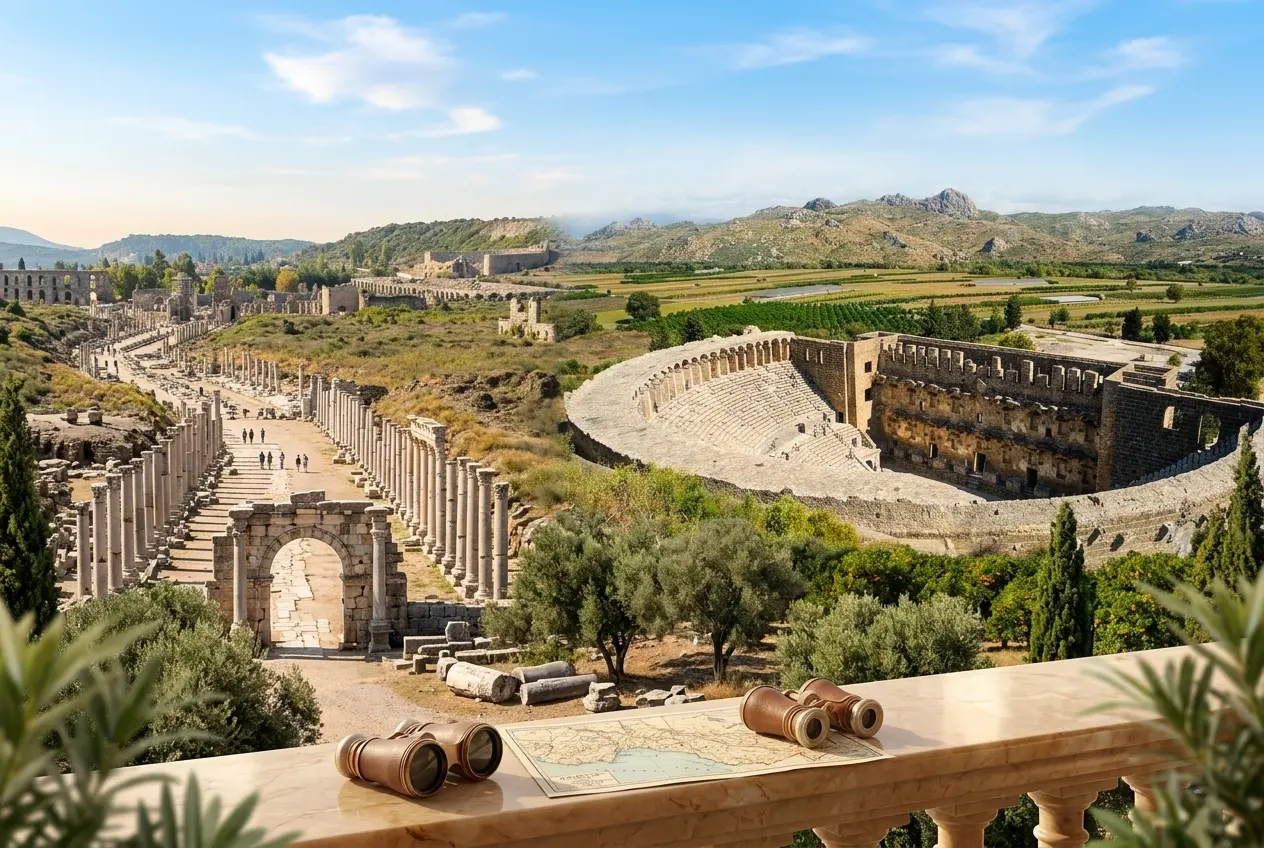
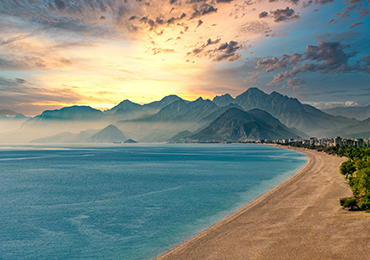
The strongest reason to come to Alanya Castle is the chance to grasp, in a single glance, eight uninterrupted centuries in the life of a Mediterranean city. From the top of the peninsula you can look to either side: on one, the deep blue infinity of the Mediterranean; on the other, the slopes of the Taurus. Below stand the bay that has served as a harbour for centuries, the octagonal silhouette of the Red Tower and the five arches of the shipyard opening onto the sea. Every historical layer of a Mediterranean city — Hellenistic coves, Roman trade routes, Byzantine ramparts, Seljuk architecture and Ottoman continuity — converges in a single view. Visitors wishing to extend their program to other ancient cities in the Antalya region may pair this guide with our Perge and Aspendos guide.
Historical Layers — From Korakesion to Alaiye
The history of Alanya reaches back to the 4th century BC. The rocky headland you now stand on was the site of "Korakesion", a small Hellenistic-period harbour town. Known as Korykos under Rome, in the 1st century AD it became one of the main bases of Mediterranean pirates and was the setting of the dramatic clearing campaign led by the Roman commander Pompey. Under Byzantium the city was called "Kalonoros" — "Beautiful Mountain" — and became a significant bishopric.
Seljuk Conquest: 1221 and the Name "Alaiye"
The city's present identity begins in 1221, when the Anatolian Seljuk Sultan Alaeddin Keykubad I conquered Kalonoros. From the moment he took the city, the sultan designed it not merely as a military outpost but as a capital. Renamed "Alaiye" after the sultan himself, the castle walls were rebuilt to stand for eight centuries. Throughout the Seljuk period, Alaiye served as the court's winter capital; the sultan's family, senior officials and artists lived inside this castle. The majority of the surviving walls, cisterns inside the castle, small mosques and the Süleymaniye Mosque in the lower castle date from this era.
A Three-Layered Defence: Inner, Middle and Lower Castle
The most striking feature of Alanya Castle is its defensive system built across three distinct levels. The Inner Castle (Ehmedek) at the very top contains the sultan's private quarters and the final refuge; it sits 250 metres above sea level. From here, four horizons of the Mediterranean are visible — the arrival of pirate ships, the approach of trade caravans, every shift in the weather were watched from a bird's-eye perspective. The Middle Castle is the area where soldiers and administrators lived; palace buildings and large water cisterns stood here. The Lower Castle was the civilian quarter, with bazaars, mosques and houses. Today, the narrow Ottoman alleys, restored stone houses and small cafés of the lower castle invite you to wander as through a living village.

The Red Tower — The Mediterranean's Octagonal Emblem
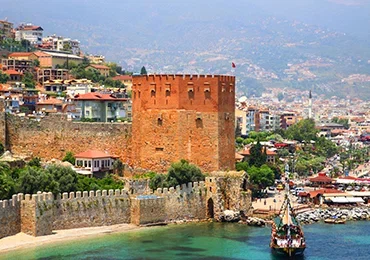
The Red Tower (Kızıl Kule) is the most recognised structure of Alanya and, more broadly, of Mediterranean Seljuk architecture. It was built in 1226 by order of Sultan Alaeddin Keykubad I; the architect was Abu Ali Reha al-Kattani of Aleppo, who had previously worked on the renewal of Sinop Castle. The tower's purpose was to create a maritime defensive stronghold guarding Alanya's two key strategic assets: the bay and the shipyard adjacent to it. The Red Tower was the first major structure the sultan commissioned after the conquest — a concrete symbol of the Seljuk claim on the Mediterranean.
Octagonal Plan, 33 Metres Tall, Red Brick
The Red Tower is an octagonal, five-storey building 33 metres high with a base diameter of 29 metres. Large cut stones were used at the lower levels; further up, fired red brick was preferred to reduce weight. The characteristic red colour that gives the tower its name comes from the brickwork of these upper levels. At the centre of the building, a large cistern and light shaft runs from the topmost floor to the ground — this cistern was the freshwater store that allowed defenders to hold out for days, even weeks, under siege. The tower was used for military purposes for centuries; it was restored in the 1950s and opened to visitors.
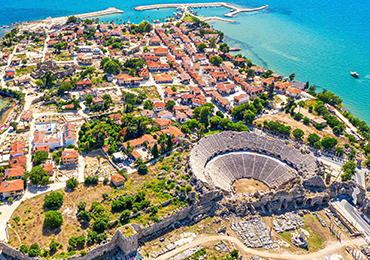
Today the Red Tower houses a small Ethnographic Museum. When you reach the top floor, an awe-inspiring panorama opens before you: the bay of Alanya, the five-arched silhouette of the Seljuk Shipyard, and the ramparts that ring the peninsula. For a photographer, this angle is among the Mediterranean's most beloved frames.
The Seljuk Shipyard — The Story Behind the "Sultan of Two Seas"
Just south of the Red Tower, a five-arched structure opens directly onto the sea: the Seljuk Shipyard. Construction began in 1227 on the order of Sultan Alaeddin Keykubad I and was completed within a single year. It was the first shipyard the Seljuk state built on the Mediterranean, following its earlier Sinop shipyard (1214) on the Black Sea. Through these two shipyards, Sultan Alaeddin Keykubad earned the title "Sultan of Two Seas" (Sultân-ı Bahreyn) — one in the north, one in the south, two gates of Seljuk seafaring.
Five Arched Bays, a 56.5-Metre Facade
The shipyard's sea-facing facade measures 56.5 metres, and its depth is 44 metres. The structure is designed as five arched "bays"; each bay is 7.7 metres wide and 42.3 metres long. The walls are of cut stone, while the arches and vaults are of brick, with skylights set into the ceilings to admit natural light. These five bays were five parallel lines for shipbuilding and repair: timber-cutting, keel-laying, caulking and rigging. A medieval "factory" capable of working on five vessels at once — designed eight hundred years ago at sea level, opening directly onto the water.
How old is the Red Tower? The Red Tower was built in 1226 by order of the Anatolian Seljuk Sultan Alaeddin Keykubad I, designed by the Aleppo-born architect Abu Ali Reha al-Kattani. As of 2026 the structure is 800 years old. With its octagonal plan, height of 33 metres and base diameter of 29 metres, this five-storey tower is among the best-preserved Seljuk maritime defensive structures of the Mediterranean and is listed, together with the Alanya Shipyard, on the UNESCO World Heritage Tentative List.
After the Seljuk era, the shipyard continued to serve under the Karamanids, the Alaiye Beylik and the Ottomans as the centre of ship construction, repair and port operations. Today it houses a small Maritime Museum, displaying antique anchors, ship models and curated artefacts from Mediterranean maritime history. Outside the shipyard, a familiar summer scene awaits: from the bays, day boats depart, carrying visitors to the natural wonders of the Mediterranean — the Damlataş Cave, the Pirates' Cave and the Lovers' Cave.
Walking Route — An Hour-by-Hour Day at Alanya Castle
Designed properly, the Alanya Castle complex can be explored thoroughly in a single day. The classic formula our Kirman Premium concierge recommends to guests is: rise early to complete the inner castle before midday, descend to sea level in the afternoon for the Red Tower and Shipyard, and close the evening at Alanya bay. This rhythm spares you the summer heat and lets you catch the most beautiful angles as the light shifts.
09:30 — Cable Car from Damlataş to the Inner Castle
Leave the hotel around 09:00 and be at the Damlataş Cable Car Station by 09:30. The roughly 900-metre cable car line carries you, in a 5–7 minute ride, to the entrance of the Inner Castle at 250 metres elevation. The brief journey is an experience in itself: beneath the cabin stretch Alanya bay, the octagonal silhouette of the Red Tower and the steep cliffs descending from the Taurus. By 09:30, the cable car is open and the inner castle has not yet filled up.
10:00 — Inner Castle (Ehmedek) and Byzantine Church
After leaving the cable car, a fifteen-minute walk brings you to the inner castle. Along the way you take in the Mediterranean spreading out in every direction from the ramparts, walking past the traces of the Seljuk palace. The small Byzantine church (St. Georges) inside the inner castle — partly ruined but with visible frescoes — gives the city's Byzantine layer concrete form. The "Kız Atan" cliff on the western face of the wall is one of the castle's age-old legends; below lie cliffs that drop straight into the sea, and no one returns without photographing them.
11:30 — Lower Castle and Süleymaniye Mosque
After exploring the inner castle, walk down to the lower castle. The lower castle inside the castle feels like a "living village": narrow Ottoman alleys, stone houses, small craft shops and ivy-draped courtyards. At its centre stands the Süleymaniye Mosque — a simple but moving structure from the 14th-century Karamanid period. A stop at a small café in the stone building next to the mosque, sipping a Turkish coffee, is the quietest moment of your day at Alanya Castle. Families typically pause here for lunch.
14:00 — Down to the Red Tower and the Ethnographic Museum
After lunch, leave the castle and descend to sea level. Here — right beside Alanya's pier — the Red Tower awaits. Climbing the five floors one by one, you find an exhibition area on each: Seljuk architecture and construction techniques on the ground floor, regional costumes on the middle floors, crafts and everyday objects above. Reaching the top — an open vaulted ceiling — you stand before a panoramic view of Alanya bay: the shipyard below, the peninsula ahead, the Taurus behind.
15:30 — Seljuk Shipyard and Maritime Museum
After leaving the Red Tower, a coastal walk of about 100 metres brings you to the Seljuk Shipyard. When you step beneath the five arched bays, you step into a moment eight hundred years past: cool stone walls, silent vaults, the soft lap of water. The Maritime Museum here recounts the currents of trade, war and culture the Mediterranean has carried since the Seljuk era through a small but carefully curated collection. Standing under the vaults and looking out to the sea, you feel the title "Sultan of Two Seas" in its truest sense.
17:00 — Late Afternoon at Alanya Harbour
At the shipyard's exit, Alanya's small but colourful harbour greets you. Sitting with a Turkish tea in the late-afternoon light, your back to the Red Tower as you gaze out across the Mediterranean, is the ideal hour. Hourly boat tours leave from the harbour in the late afternoon (17:00–18:30), circling Damlataş Cave and the Lovers' and Pirates' Caves — a romantic sunset closure, especially for families. If you set off back around 19:00, you arrive in Okurcalar by 19:40; after a full day of cultural travel, dinner at the hotel is more than earned.
How long does it take to visit Alanya Castle? If you intend to see only the inner castle and the Red Tower, 3–4 hours is enough. With the lower castle, Süleymaniye Mosque and the Shipyard added, the ideal duration is 5–7 hours. Touring the entire complex (inner, middle and lower castles, Red Tower, Shipyard and harbour) with lunch and afternoon breaks makes for an 8–9 hour day trip. Avoiding the inner castle between 11:00 and 14:00 in the summer months significantly reduces fatigue.
Seven Places to See
The entire Alanya Castle complex can be explored in one day; knowing exactly what to see clarifies your itinerary. Here are seven essential headings:
1. Red Tower: 1226, Seljuk maritime defence. 33 metres, octagonal, five floors. Houses the Ethnographic Museum.
2. Seljuk Shipyard: 1227, five arched bays, 56.5-metre facade. The first Seljuk shipyard on the Mediterranean. Maritime Museum.
3. Inner Castle (Ehmedek): The castle's highest point at 250 metres. Traces of a Byzantine church, panoramic views, the "Kız Atan" cliff.
4. Lower Castle (Lower Town): A living Ottoman-village atmosphere — narrow alleys, stone houses, small cafés.
5. Süleymaniye Mosque: 14th century, Karamanid period. In the heart of the lower castle, a simple and serene example of religious architecture.
6. Tophane: The arsenal bastion at the closest point of the walls to the shore. Directly overlooking the Mediterranean, a key node in the military history of the castle.
7. Alanya Archaeological Museum: Not on the castle hill but at sea level, near Damlataş. It gathers in one place the Mediterranean history drawn from finds across the region's ancient cities. Roman and Hellenistic artefacts are here.
Within the wider cultural calendar of the Alanya region, those wishing to attend the Aspendos Festival may consult our Aspendos Opera and Ballet Festival 2026 guide; for a comprehensive list of ancient cities, our Antalya's historical treasures piece is the best starting point.
Who Is Alanya Castle For?
Couples and Honeymooners
The Mediterranean seen from the inner castle's high walls, the changing red of the Red Tower's brickwork at sunset, the soft echo of water under the Seljuk Shipyard's vaults — all of these become the silent ingredients of a romantic stay. The best hours for couples at Alanya Castle are the hour before sunset; walking down the stone road from the inner castle to the lower castle in the Mediterranean's golden hour is the moment most photographed. For a honeymoon-focused program, our Premium Honeymoon concept guide adds further ideas; the detailed service package is set out on the Premium Honeymoon concept page.
Families
For children aged 8 and over, Alanya Castle becomes a living history class. Looking out at the Mediterranean from the ramparts, peering up through the central well of the Red Tower's cistern, playing hide-and-seek among the arched bays of the Shipyard — the medieval Turkish seafaring of textbooks turned into something concrete. For younger children, the cable car ride and the evening lights of the harbour below are enchantment enough. For the rest of a family-focused stay, our comparison of family hotels with aquaparks is a useful companion.
Culture Lovers and Photographers
With its overlapping Hellenistic, Roman, Byzantine, Seljuk, Karamanid and Ottoman layers, Alanya Castle is one of the richest single-site experiences Turkey can offer enthusiasts of history and architecture. For professional photographers the strongest hours are early morning (07:30–09:00, on the eastern side of the inner castle) and late afternoon (18:30–19:30, Red Tower's golden hour). Entering the shipyard just after sunset offers the most cinematic moment, when the five arched bays fill with soft, golden light.

Practical Information — Cable Car, Transport, Fees
Transport: From the Okurcalar region where the Kirman Premium hotels are located, Alanya centre is 31 kilometres away — about 38 minutes by car. From Antalya Airport, the distance is 125 km (approximately 1 hour 30 minutes). Our concierge arranges private transfers via partner services; group tour services are also available. For a general overview of transfers, our Antalya flight and transfer guide provides detailed information.
Cable Car: A 900-metre cable car line runs from the Damlataş station to the Inner Castle entrance. The journey takes 5–7 minutes. Summer operating hours are 09:30–20:00. For families travelling with older relatives or children, the cable car is by far the most comfortable option compared with climbing the slope. The bird's-eye Mediterranean panorama from the cabins is itself a visual highlight.
Visiting Hours and Entrance Fees: Alanya Castle is open in summer (1 April – 1 October) from 08:30 to 19:00 and in winter from 08:30 to 17:30. The 2025 entrance tariff is around 60 TL; visitors under 18 and local residents over 65 enter free. For up-to-date 2026 fees, the most reliable reference is the Turkish Ministry of Culture and Tourism's official sources. The museums inside the Red Tower and Shipyard may be priced separately; Museum Card holders are exempt from many entrance fees.
Dress: The entire route involves at least 4–5 kilometres of walking, so comfortable sports shoes are essential. In summer, light cotton or linen is recommended, with a cardigan or shawl for the cooler evening. Visiting the Süleymaniye Mosque requires clothing that covers the knees and a shoulder cover. A hat, sunglasses and sunscreen are essential in summer — shade is limited at the top of the inner castle.
Best Season: March–May and September–November are the ideal periods for Alanya Castle — neither too hot nor too cold, with extended golden hours for photography. June–August can be hot, but the early-morning and late-afternoon windows are pleasant; midday hours are best avoided. In winter (December–February) Alanya's mild climate keeps the castle accessible; the streets are quiet and the light from the sea sits lower — a special silence for photographers.
2026 Alanya Castle tips: The busiest hours are 12:00–15:00; at this time the inner castle offers little shade, and queues lengthen at the Red Tower entrance. The strongest photographic vantages are the western walls of the Inner Castle (for sunset), the terrace floor of the Red Tower (for Alanya bay) and the sea-facing entrances of the Shipyard bays. Carry a refillable water bottle — there are few cafés inside the castle. Prefer waterproof footwear; some stones near the old Byzantine church inside the inner castle may be damp.

A Day at Alanya Castle from Kirman Premium
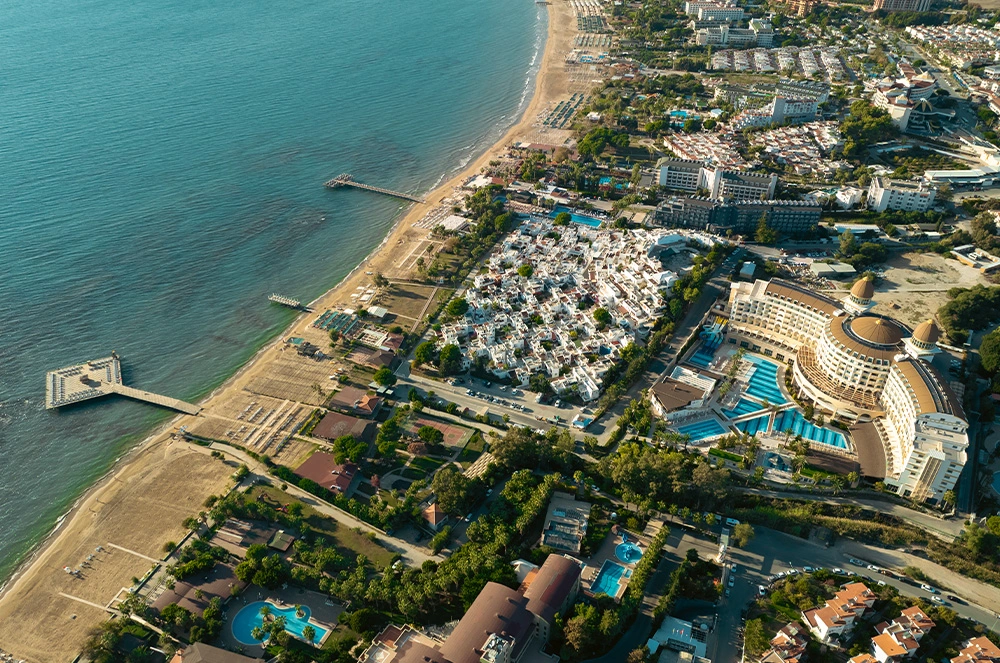
If you decide to set aside one day of your stay for Alanya Castle, the journey from any of the Kirman Premium hotels in Okurcalar — Sidera, Arycanda or Leodikya — is easy. The distance is just 31 kilometres and the drive 35–40 minutes; setting out after breakfast and returning in time for dinner is an entirely comfortable plan. For guests travelling from the Side region (Sidemarin, Calyptus), the distance is approximately 70 km; in that case an early-morning departure with an evening return — or an overnight stay in Alanya — makes the day more rewarding.
Our concierge can plan a classic Alanya Castle day as a "premium day trip": private transfer from the hotel at 09:00, optional local-guide-led entry to the cable car at 09:30, a family lunch break in the lower castle at midday, the Red Tower and Shipyard in the afternoon, a Turkish coffee at the harbour viewpoint at evening, and a return at 19:00. To decide which hotel best suits the Alanya Castle route, our comparison of the five Kirman Premium hotels provides a clear starting point.
For guests wishing to extend the Alanya day with a boat tour, our Antalya day tours guide serves as a reference; for a sea-led holiday plan, our best beaches of Antalya piece is the natural complement. For Kirman Premium's sustainability and cultural-responsibility approach, the Premium for Universe concept page is worth reading; the brand's position on the Mediterranean coast is summarised on the About the hotel page.
A Final Word: Alanya Castle, the Mediterranean's Eight-Century Sentinel
Alanya Castle is not a line in a tour itinerary but the eight-century summary of a Mediterranean city. Watched over by Hellenistic sailors, used by Roman pirates, named by Byzantine bishops and rebuilt by Seljuk sultans, this rocky promontory still gazes upon the same sea. Standing on its walls — half an hour by transfer from the Kirman Premium hotels — you feel in concrete terms the importance the "Sultan of Two Seas" placed on the sea: the octagonal silhouette of the Red Tower, the five arched bays of the Shipyard, the cliff face of the Inner Castle — all parts of one whole.
After your June 2026 Kirman Premium reservation, our concierge will design your Alanya Castle day at exactly the rhythm you want: a family cultural walk, a romantic sunset for couples, a golden-hour-focused program for photographers. Whatever the format, the memories you leave on the stone walls of the castle — the blue of the Mediterranean, the brick red of the Red Tower, the vaulted acoustics of the Shipyard — become the silent yet most lasting parts of your premium stay.
-
 Summer Enjoyment Continues at Kirman Premium with Heated Pools!
 -
 Kirman Premium At ATF 2026!
 -
 Oktoberfest Excitement at Kirman Premium
 -
 Starry night at Sidera Kirman Premium: Gökhan Tepe
 -
 Republic Day 2026 in Antalya: A Four-Day Break at the End of October
 -
 October Half Term in Antalya 2026: A Family Guide to Autumn Sun
 -
 Antalya in October 2026: Weather, Sea Temperature and Can You Swim?
 -
 Oktoberfest in Antalya: Bavarian Spirit in September and October
 -
 Things to Do in Antalya in September: Festivals and Late-Summer Events
 -
 Things to Do in Antalya in August: Events and Summer Activities
 -
 Antalya in August: Sea Temperature & Weather Guide 2026
 -
 September in Antalya 2026: Warmest Sea, Calmest Season
 -
 Dim River & Dim Cave: Alanya's Cool Valley 2026
 -
 Green Canyon Boat Tour 2026: A Cool Escape from Side
 -
 Night Museum 2026: Side & Aspendos Ancient Cities by Moonlight











![Kirman Premium 5 Hotel Comparison: Which Resort Is Right for You? [2026]](https://www.kirmanpremium.com/image/icerik/6985529a11cfe.png)









Special offers for you Join the Kirman Premium world!







#kirmanpremium


